Why HyperFrames Clicked for Me Faster Than Remotion
I’ve been paying more attention to tools that make AI output easier to inspect.
That’s why HyperFrames got my attention fast.
A lot of AI video tools still feel like a black box. You type a prompt, wait, and hope the result is usable. HyperFrames feels closer to software. You can see the composition, change it, preview it, and render it again. I trust that model more.
The obvious comparison here is Remotion.
Remotion is more mature and more familiar if you already like building things in React. If I wanted a deeper, app-like video system, I’d still take Remotion seriously.
But for Hermes, HyperFrames feels easier to control.
Remotion makes me think in components, props, and a bigger React-shaped system. HyperFrames feels narrower. In this case, that’s a good thing. When an agent is generating the first draft, I’d rather give it a smaller surface area and a clearer path to something valid.
So my take is pretty simple:
- Remotion feels stronger as the established engineering platform
- HyperFrames feels better suited for quick agent-driven composition and iteration
That’s why it clicked for me.
The architecture flow I’d use
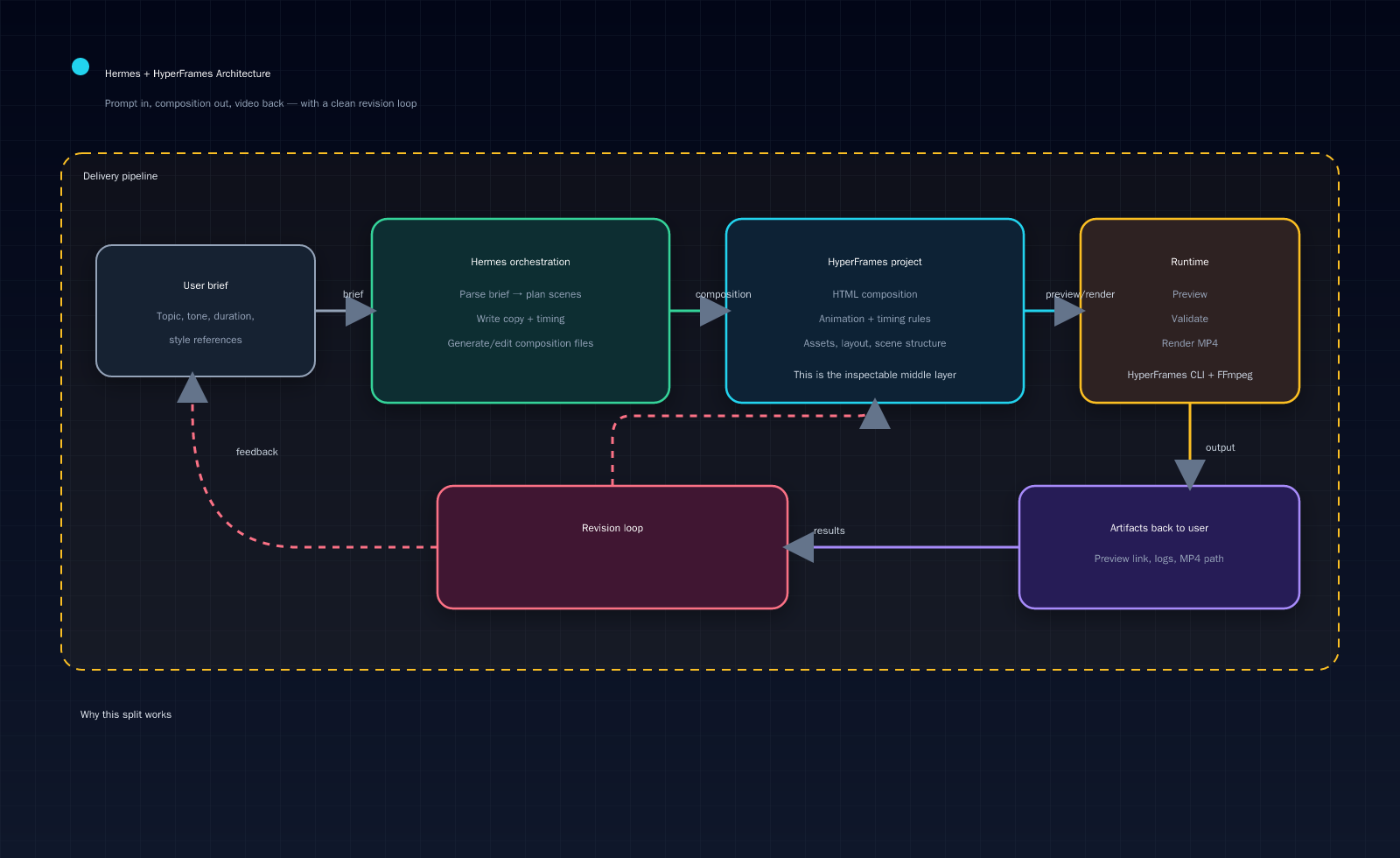
The split I want is also pretty clean:
- Hermes takes the brief
- Hermes turns it into scenes, copy, and timing
- Hermes writes or edits the HyperFrames composition
- HyperFrames handles preview and render
- Hermes returns the final MP4 and supports revision requests
That keeps Hermes in the orchestration role instead of turning it into a video engine.
A simple video result
The video above is a small smoke test, not a polished production example. That’s fine. The point was to prove the loop works end to end: brief, composition, preview, render, MP4.
That’s the part I actually care about.
If Hermes can reliably take a short brief, generate a first pass, accept revision feedback, and rerender without the whole thing falling apart, then this gets interesting very quickly.
That’s why I’m more excited by HyperFrames than by a lot of “just prompt a video” tools.
It feels less like magic, and more like a system I can actually build around.
Keep reading